onsdag 20. juli 2011

Mercredi/ Wednesday 20.07.2011. Torshavn

Tout le monde nous a conseillé d’aller à Vestmanna, une petite ville sur la même ile que Torshavn  (Streymoy) mais beaucoup plus au nord-ouest. A Vestmanna, on peut aller sur un bateau qui emmène les touristes voir les falaises sur la côte ouest. Elles sont spectaculaires et de nombreux oiseaux de mer y nichent. La distance de Torshavn à Vestmanna est de 39 km. Jens va au bureau du tourisme, à deux minutes d’ici se renseigner sur l’horaire des bus et l’horaire du bateau là-bas. Il rentre et m’annonce que le bateau à Vestmanna part à 14 h et que le bus de Torshavn à Vestmanna arrive là-bas à … 14 h 30 ! Que faire ? Aller à Vestmanna en vélo et rentrer en bus. Sitôt dit, sitôt fait. Il est déjà 9 h 45. On se prépare rapidement (sandwichs, eau, noix et raisins et bonbons à la menthe, plus cirés et bottes) et à10 h on part.
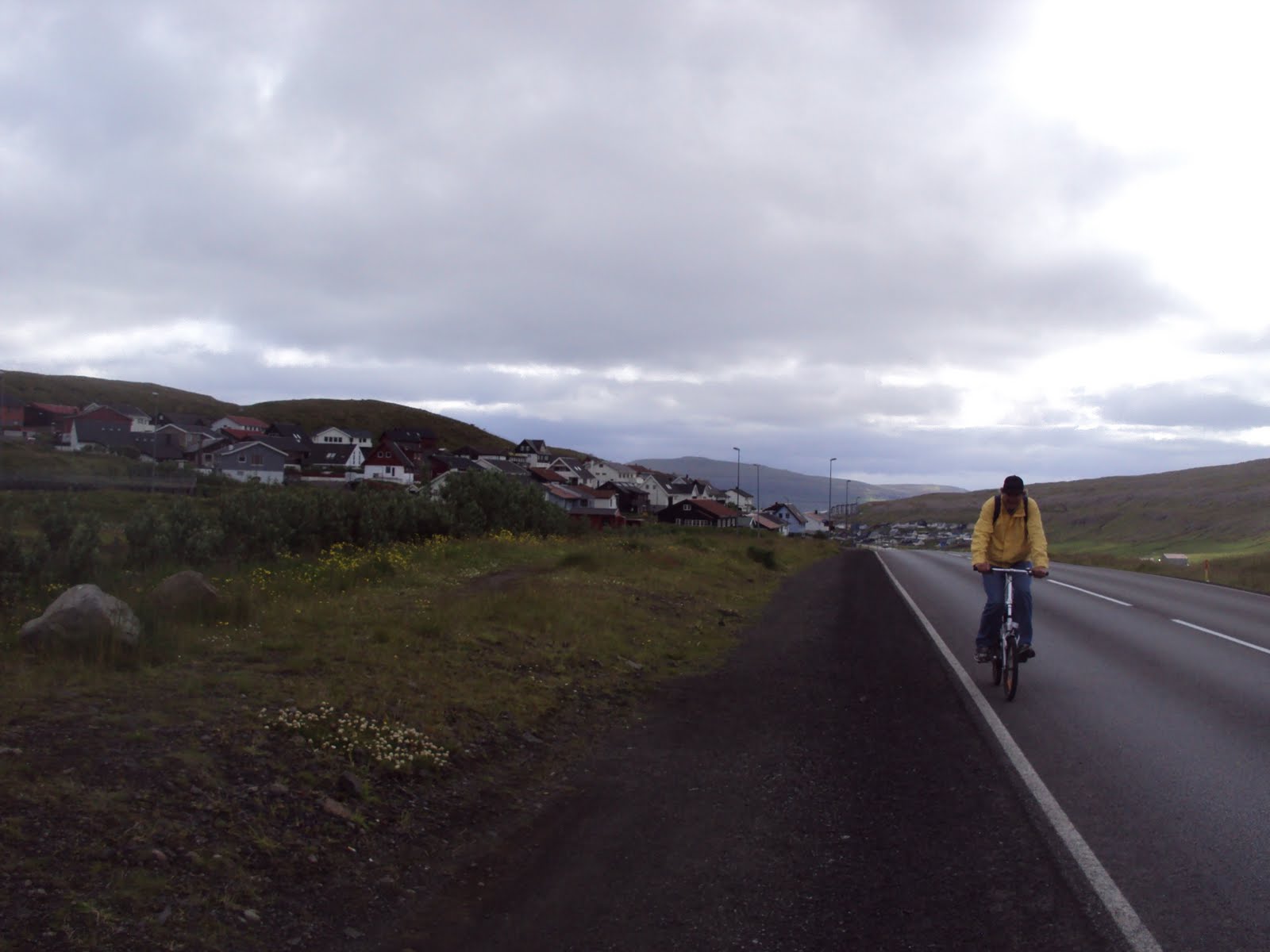
La route monte, vous devez commencer à connaitre l’histoire. Il ne fait pas chaud et gris. C’est la route qui va à l’aéroport. Il y a pas mal de circulation mais la route est large et les voitures s’écartent bien. On passe un tunnel, éclairé et large. On a nos lumières et tout va bien. On a calculé qu’il faut à peu près faire une moyenne de 10 km//h si on veut arriver bien avant le départ du bateau. Donc on roule bien et on ne s’arrête pas beaucoup. Plus loin, la route se divise en deux, à droite un tunnel sous la mer va à l’ile de Vágar où se trouve l’aéroport et à gauche la route va à Vestmanna. Ce nom vient, parait-il, de « hommes de l’ouest », mann= homme et vest=ouest. Ce serait des moines irlandais venus christianiser les Féroé qui seraient ces hommes de l’ouest. On passe près d’un joli village niché au bord du fjord, Kvívik. De là on est à 12 km de Vestmanna et ça monte, monte. A chaque courbe, ce ne sont pas des virages mais de légères courbes, on espère que ça va commencer à descendre, mais non. Pourtant on va descendre, Vestmanna est comme tous les villages et villes ici au bord de la mer. J’ai l’impression que de ces 12 km, 9 montent et 3 descendent. Mais la descente est la bienvenue. On arrive à Vestmanna à 13 h 20. Un peu fatigués, mais ça va. On mange nos sandwichs sur le quai et on va boire un café. Puis on embarque sur le bateau. Nous sommes une trentaine, je crois. On peur être à l’intérieur ou à l’extérieur. Et on nous distribue … des casques ! Nous sortons du fjord, Vestmanna est au fond d’un fjord qui fait une courbe et c’est très bien protégé. Nous passons près d’un groupe de 4 maisons inhabitées, sans chemin. Mais il y a de l’activité aujourd’hui. Les gens sont venus en bateau pour la tonte des moutons. Il fait du soleil et la mer est calme. Puis on longe les falaises. C’est impressionnant, même sur des pentes très raides, sans accès, il y a des moutons. On les amène en bateau au printemps et on les met à terre avec des treuils et des cordes. Puis on vient les chercher à l’automne.
Les falaises sont grandioses, la plus haute fait 600m, à pic au dessus de la mer. Des oiseaux nichent dans des petits creux, mais on n’en voit pas beaucoup. Penser que des œufs et des oisillons sont sur une « étagère » étroite à 300-400 m là-haut !
Le capitaine du bateau est très bon. On passe entre des ilots, on va dans des grottes (d’où les casques, si on reçoit des pierres sur la tête) et tout ça exposé à la Mer du Nord, qui n’est pas habituellement très aimable. Mais c’est un bon jour.
Ce tour dure deux heures et à 16 h on rentre. Nous prenons le bus à 16 h 20. On plie les vélos et on les met dans le compartiment pour les bagages. Cette fois c’est un grand bus. Nous devons changer de bus une fois. Et nous arrivons à Torshavn à 17 h 30, fatigués et ravis de notre journée.
Sur le quai de la marina, la première personne qu’on voit, c’est Hans Jørgen. Ils sont arrivés aujourd’hui et c’était bien eux qu’on a vus hier, rentrant dans le port de Hestur. Ils ont acheté des crevettes et nous invite à une crevette-partie, nous et notre autre voisin danois, sur le quai où il y a des tables. Très sympa. Eux aussi ont eu des vagues et des problèmes de courant. Nous dégustons les crevettes avec pain, mayonnaise et citron ; et nous buvons de la bière. Devinez de quoi on parle ? De bateau !         

Everyone advised us to go to Vestmanna, a small town on the same island as Torshavn (Streymoy) but more to the northwest. At Vestmanna, we can go on a boat that takes tourists to see the cliffs on the west coast. They are spectacular and many sea birds nest there. The distance to Vestmanna from Torshavn is 39 km. Jens goes to the tourist office, two minutes from here, to ask about bus schedules and the schedule of the boat there. He comes back and tells me that the boat in Vestmanna starts at 2:00 pm and the bus arrives from Torshavn to Vestmanna at  2:30 pm! What can we do? Go to Vestmanna by bike and go back by bus. No sooner said than done. It's already 9:45 am. We get ready quickly (sandwiches, water, raisins and nuts, and mints, plus rain cloth and boots) and at 10:00 am, we are on the road.
The road climbs, climbs, you must begin to know the story. It is cold and gray. This is the road to the airport. There is a quite a lot of traffic but the road is wide and the cars pass us with a good margin. We pass a tunnel, lit and wide. We have our lights and no probleml. We have calculated that we must have an average of 10 km/h if we want to arrive well before the departure of the boat. So we ride well and we do not stop much. Further on, the road splits in two; to the right a tunnel beneath the sea goes to Vágar Island where the airport is and to the left, the road goes to Vestmanna. The name comes, it seems, of "men of the west";  mann = man and  vest= west. It could be the Irish monks who came to Christianize the Faroes who would be the  men of the west. We pass close to a pretty village nestled on the banks of a fjord, Kvívik. From there it is 12 km to Vestmanna and the road climbs and climbs. At each curve, we hope that it will begin to descend, but no. Yet we have to go down, Vestmanna is, like all the villages and towns here, by the sea. I feel like of these 12 km, 9 are up and 3 are down. But the descent is welcome. We arrive at Vestmanna at 1:20 pm, a little tired but fine. We eat our sandwiches on the pier and we drink coffee in a café. Then we board the boat. We're about thirty persons, I think. We can be inside or outside on the boat.  And we get helmets! We leave the fjord, Vestmanna is at the bottom of a fjord that curves and is very well protected. We pass by a group of four uninhabited houses, without road. But there is activity today. People came by boat to sheep shearing. The sun comes out and the sea is calm. Then we pass along the cliffs. It's impressive, even on very steep slopes, with no access, there are sheep. They are brought by boat in the spring and placed on the ground with ropes and winches. Then they are taken out in the fall.
The cliffs are spectacular, the highest is 600m; the sea birds nest in small hollows, but we do not see many. To think that eggs and chicks are on a narrow "shelf" 300-400 m up there!
The captain is very good. We pass between small islands, we're going in caves (hence the helmets, so we don’t get stones on the head) and all that exposed to the North Sea, which is not usually very quiet. But it is a good day today.
This tour lasts two hours and we come back at 4:00 pm. We take the bus at 
4:20 pm. We fold the bikes and placed them in the compartment for luggage. This time it is a big bus. We have to change bus once. And we arrive at Torshavn at 5:30 pm, tired and happy with our day
On the pier, the first person we see is Hans Jørgen. They arrived today and it was them we saw yesterday, entering the harbour of Hestur. They bought shrimps and invite us to a shrimps-party, us and our Danish neighbor, on the pier where there are tables. Very nice. They too have had problems with waves and currents. We eat the shrimps with bread, mayonnaise and lemon, and we drink beer. Guess what we talk about? Boats!


La route
The road


Un escalier à saumons
Salmon stairs


Kvívik


La route, là-bas
The road, over there


Vestmanna
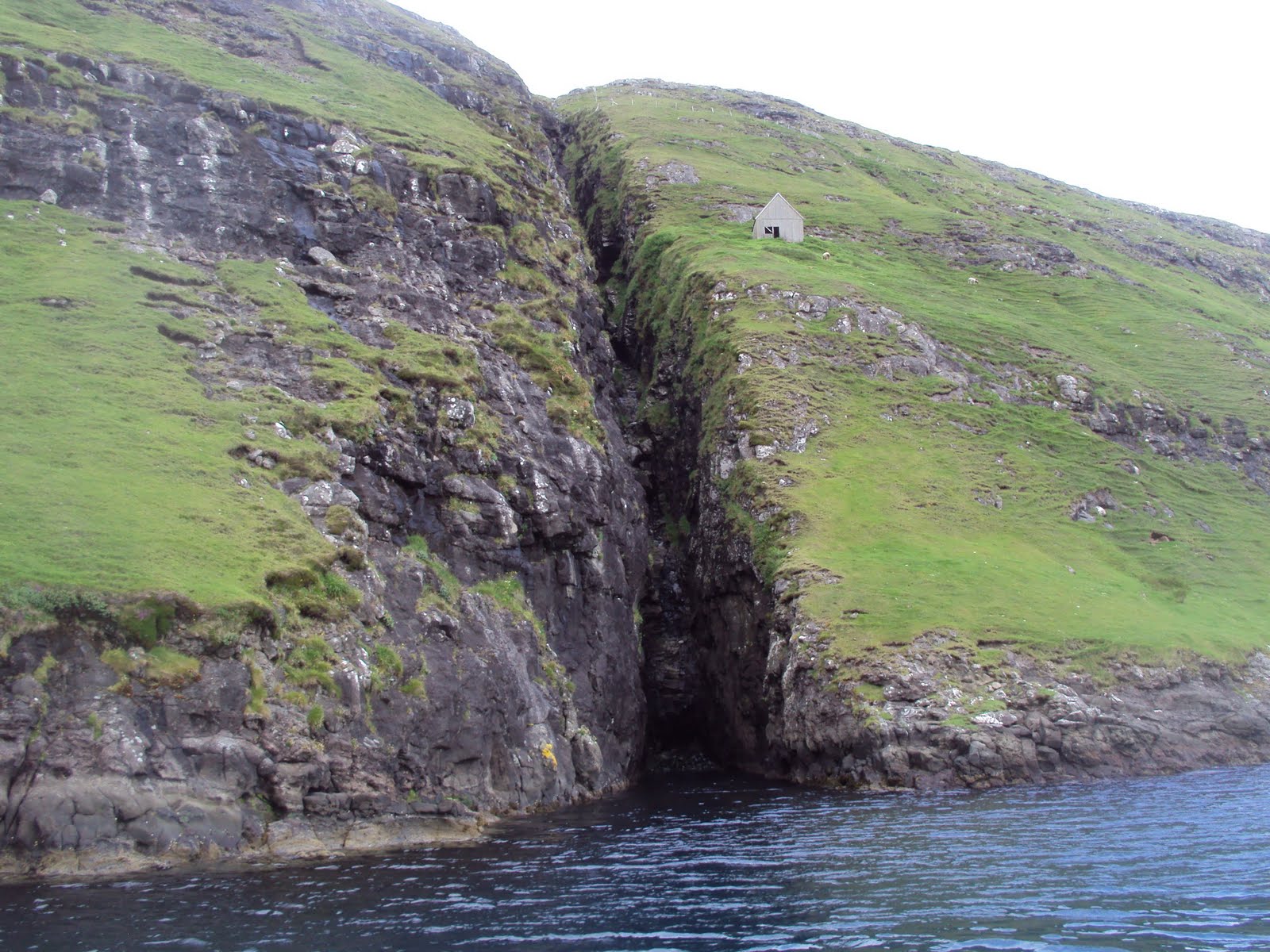

Il y a des moutons!
There are sheep!

Jens avec un casque
Jens with a helmet


Jeannette avec un casque
Jeannette with a helmet


Tonte des moutons
Sheep shearing


Casque à la mer!
Helmet over board!


Falaise et grotte
Cliff and cave


L'éléphant. On passe autour avec le bateau
The elephant. We sail around with the boat.


Nids d'oiseaux
Bird's nests
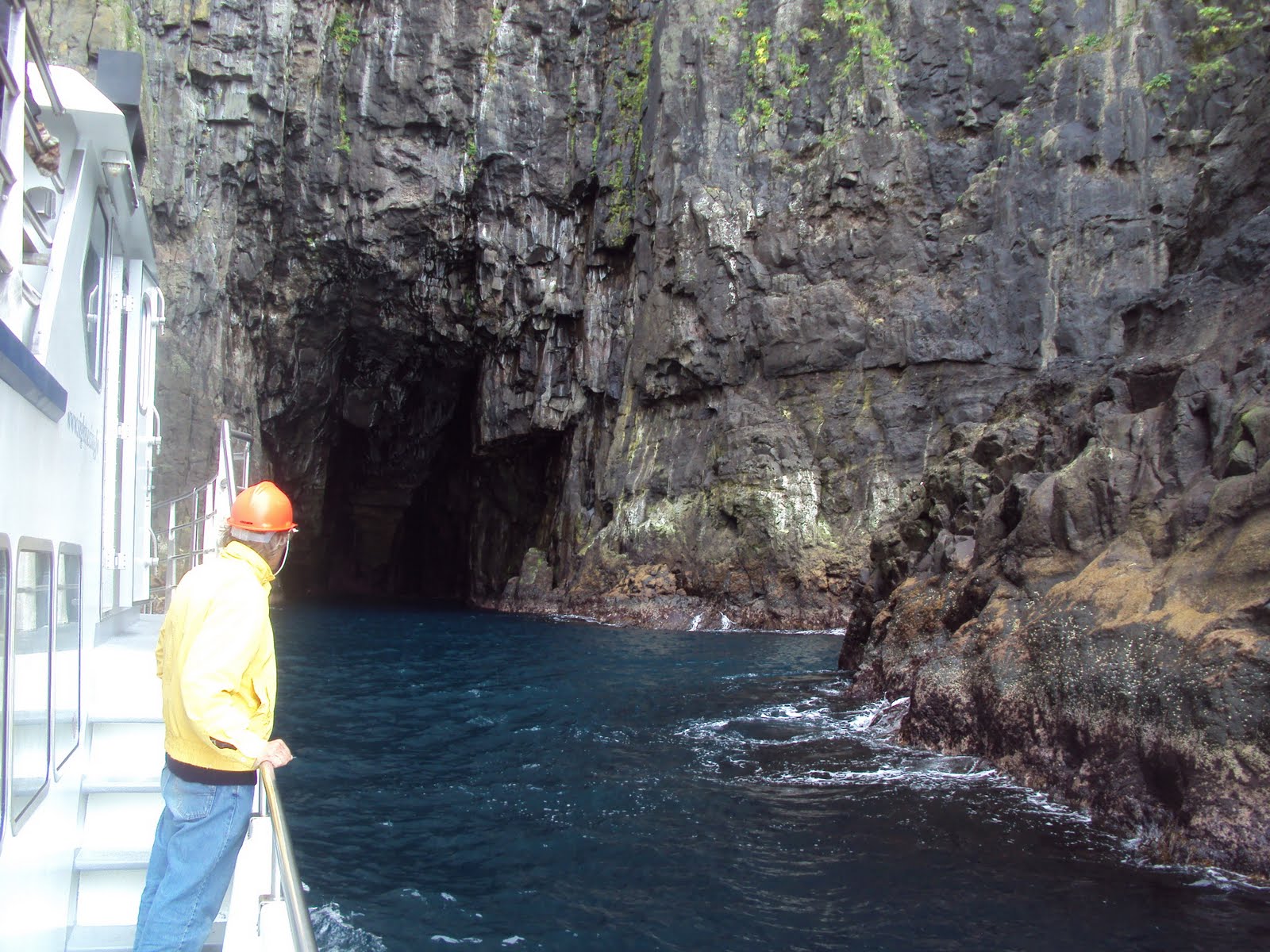

Le bateau rentre dans une grotte
The boat goes into a cave


Une faille
A fault


Dans une grotte
Inside a cave


Motif de tricot, Iles Féroé
Knitting pattern, Faroe Islands


tirsdag 19. juli 2011

Mardi/ Tuesday 19.07.2011. Torshavn

Il y a longtemps qu’on n’a pas fait un tour en vélo. Il est temps de s’y remettre.
Nous partons à 11 h vers le sud pour aller voir un endroit qui s’appelle Kyrkjubóur. Nous sortons de Torshavn et traversons un nouveau quartier sur une colline. Un arrêt de bus nous parait ingénieux : il est construit comme un X, c’est à dire que l’on peut être â l’abri du vent  quelque soit sa direction.
Nous voyons, comme d’habitude, des moutons et des oies. Au fait, dimanche, en voiture, on a vu un lièvre. Mais il n’y a pas de lapins ici.
La route monte doucement et longtemps. On passe au dessus du quai du ferry de Sandoy et on voit le ferry arriver. On monte encore un peu, c’est bien, comme ça on n’a pas froid, puis on redescend sur Kyrkjubóur. C’est un endroit spécial parce qu’au moyen âge, c’était le centre religieux des Iles Féroé. Il y a une petite église et les ruines d’une cathédrale qui n’a jamais été finie. C’est un endroit joli et très calme, ouvert vers la mer.
Nous remontons et longeons la côte. Nous voyons en face l’ile de Hestur. Un bateau à voile est en train de rentrer dans le port. Jens pense que ce pourrait être Hans Jørgen et Bente que nous avions rencontrés à Tvøroyri.  Mais, comme on a oublié les jumelles, on ne sait pas. Un peu plus loin, dans un village appelé Velbastađur, un choix se présente à nous : rentrer à Torshavn ou aller voir un autre petit village à 8 km d’ici, Syđradalur. On a déjà fait plus de 20 km et 16 de plus, ça fait un peu beaucoup. On décide d’aller un peu sur cette route pour voir. C’est une jolie vallée, les champs sont plus grands et certains sont fauchés avec des faucheuses. Ça monte, monte. Arrivés à un virage où on peut voir en bas, on voit le « village », c’est en fait une ferme et c’est tout ; et c’est loin, loin en bas. On ne va donc pas y descendre et on fait demi-tour. Nous repassons à Velbastađur, et contrairement à de nombreux villages en perte de vitesse, celui-ci parait dynamique, il y a plusieurs maisons neuves. C’est sur le bord d’un fjord, à la campagne et à 10 mn en voiture de Torshavn.
Et nous rentrons en montant, montant et descendant, descendant.
Nous arrivons au bateau vers 17 h après avoir pédalé 35 km sur nos vélos pliants à trois vitesses.


It has been a long time without a bike ride. It is time to do it again.
We start at 11:00 am south to go to a place called Kyrkjubóur. We leave Torshavn and pass a new neighborhood on a hill. A bus stop seems ingenious: it is built as an X, meaning that people can be protected from the wind, regardless of wind direction.
We see, as usual, sheep and geese. By the way, Sunday, by car, we saw a hare. But there are no rabbits here.
The road climbs gently but for a very long distance. We pass above the ferry dock from Sandoy and we see the ferry coming. We climb again and it is good, we are not  cold, then down to Kyrkjubóur.This is a special place, because, in the Middle Age,  it was the religious center of the Faroe Islands. There is a small church and the ruins of a cathedral that was never finished. It is a nice and quiet place, open to the sea.
We climb again and follow the coast. We see across the fjord the island of Hestur. A sailing boat is now entering the harbour. Jens thinks it could be Hans Jørgen and  Bente, the couple we met in Tvøroyri. But, as we forgot the binoculars, we don’t known. A little further on, in a village called Velbastađur we have a choice to make: to go directly back to Torshavn or to go to another small village 8 km from here, Syđradalur. We have already done more than 20 km and 16 more is a bit much. We decide to go a little on the road and see. It's a pretty valley, the fields are larger and in some the grass is cut with big machines. The road climbs and climbs. Arrived at a turn where we can see below, we see that the "village" is actually a farm and that's it, and it is far, far down. We are not going to go down and we make an U-turn. We go back to Velbastađur, and unlike many villages in decline, this one seems dynamic, there are several new homes. It is on the edge of a fjord, in the countryside and 10 minutes drive from Torshavn.
And we ride up, up and down, down.
We arrive at the boat at 5:00 pm, having done 35 km on our folding bikes with only three speeds.


L'arrêt de bus ingénieux
The ingenious bus stop


Jens, à la sortie de Torshavn
Jens, out of Torshavn


Route et moutons
Road and sheep


Le ferry de Sandoy arrive
The Sandoy ferry arrives


L'église de Kyrkjubóur
The church, Kyrkjubóur


Ruine de la cathédrale
Cathedral's ruins


Ruines de la cathédrale
Cathedral's ruins


Encore un arrêt de bus ingénieux, tourné de l'autre côté
Another ingenious bus stop, turned against the wind


Un mouton qui se gratte contre la poubelle
A sheep scratching itself against the litter box


Des champs fauchés
The grass is cut with machines


Maisons neuves à Velbastadur
New houses, Velbastadur


Torshavn


Motif de tricot, Iles Féroé
Knitting pattern, Faroe Islands


mandag 18. juli 2011

Lundi/ Monday 18.07.2011. Torshavn

Il fait gris. Nous restons un peu au bateau. Je classe les photos et essaye de rattraper mon retard de blog. J’écris samedi !
Nous allons faire des courses dans un centre commercial qui s’appelle SMS. C’est à 15 mn à pied. Grand centre, moderne qui pourrait être à Oslo, Paris ou Madrid. Les boutiques de mode sont nombreuses et présentent des robes d’été et des sandales. Grand supermarché bien achalandé de produits qui viennent surtout du Danemark. Nous cherchons un journal en danois mais on a du mal à en trouver. Il n’y en a qu’un seul et rien en anglais. Je vais voir une boutique de tricots mais il n’y a que quelques modèles traditionnels dans un coin, le reste est moderne. Je demande si je peux faire des photos, pas de problèmes. Je crois que la tradition du tricot a pratiquement disparu ici. Comparé avec les Shetland où une boutique comme celle de Louise regorgeait de modèles traditionnels, où il y avait un musée du tricot et où le savoir était toujours là. J’avais demandé au bureau du tourisme à Tvøroyri des renseignements sur la manière de tricoter des Iles Féroé, mais la dame ne savait pas grand-chose. Dommage.
Nous achetons tout ce qu’il faut pour faire un bon diner. Nous avons Hjørdis et Christian ce soir.
L’après-midi, nous repartons à pied et allons dans un parc en ville. C’est boisé, assez grand et une petite rivière où on voit des truites le traverse. C’est étonnant, on penserait que les arbres sont courants ici, mais si on sort de la ville, plus un arbre.
Je mets les poireaux à cuire et Jens fait une mousse au chocolat.
Hjørdis et Christian arrivent et nous passons une très bonne soirée. Nous buvons un bon vin que Kristin a offert à Jens pour le remercier de son aide quand il a  réparé sa voiture. 
Puis vaisselle et une demi-heure de lecture pour Jens et sudoku pour moi et au lit.    

The day is grey. We stay on the boat. I classify the pictures and try to catch up the blog. I write Saturday today!
We go shopping in a mall called SMS. It is a 15 minutes walk. Big modern center, which could be in Oslo, Paris or Madrid. Fashion shops are numerous and have summer dresses and sandals. Large well-stocked supermarket with products that come mainly from Denmark. We seek a Danish newspaper, but it's hard to find. There is only one and nothing in English. I go to a knitting shop but there are only a few traditional jumpers in a corner, the rest is modern. I ask if I can take pictures, no problem. I think the tradition of knitting has virtually disappeared here. Compared with Shetland, where a shop like Louise’s was full of traditional models, where there was a museum of knitting and where knowledge was still there. I asked the tourism office in Tvøroyri information about knitting on  the Faroe Islands, but the lady did not know much. Too bad.
We buy everything we need to make a good dinner. We have Hjørdis and Christian tonight.
In the afternoon, we go and walk in a park in town. It's a large park with many trees and a small river where we see trout runs through it. It's amazing, one would think that trees are common here, but if you leave the city, no more trees.
I put the leeks to cook and Jens makes ​​a chocolate mousse.
Hjørdis and Christian arrive and we spend a very good evening. We drink a good wine that Kristin has offered Jens to thank him for his help when he repaired her car.
We wash the dishes and then half an hour reading for Jens and sudoku for me and in bed.


Un garde-manger traditionnel, Torshavn
A traditionel pantry, Torshavn


Le parc, Torshavn
The park, Torshavn


Le parc
The park


Christian, Hjørdis


Motif de tricot, Iles Féroé
Knitting pattern, Faroe Islands


søndag 17. juli 2011

Dimanche/ Sunday 17.07.2011. Torshavn

Matinée tranquille, petit tour en ville et lunch sur le bateau. Il fait assez beau.
Hjørdis et Christian viennent nous chercher à 14 h pour nous emmener visiter des endroits qui sont trop éloignés pour y aller en vélo. Nous sortons de Torshavn vers le nord-ouest et montons sur une grande montagne, en voiture. Il y a une route là parce que, auparavant, il y avait des antennes utilisées par l’OTAN, sur cette montagne. D’un coup on se sent en haute montagne, surtout quand on sort de la voiture. Il fait froid, il souffle un fort vent du nord et la végétation est chétive. Cette montagne s’appelle Sornfelli et a une altitude de 749 m. Mais nous sommes si au nord et l’influence du Golf Stream  ne se faisant pas sentir en altitude, 749 m ici correspond à, je ne sais pas, peut-être 1500m en France.
Nous allons ensuite Saksun, un très joli endroit au fond d’un petit fjord et où il y a une vieille petite église. Ce petit fjord était utilisé autrefois par des grands bateaux. Mais après une tempête au 19 eme siècle, le fjord s’est ensablé et n’est plus praticable par les grands bateaux. Il reste juste un passage étroit, assez profond, entre les bancs de sable que les locaux utilisent avec des petits bateaux.
Hjørdis me raconte que les petites marques rouges et jaunes le long des routes (j’en avais fait une en photo où un mouton s’était frotté et avait laissé de la laine) sont appelées des prêtres. Je ne comprends pas. Mais si, comme les prêtres, elles montrent le bon chemin, mais ne le prennent pas elles-mêmes ! Humour des Féroé.
Nous allons prendre un café à Eidi, sur l’ile d’Eysturoy (presque comme notre Østerøy à côté de Bergen). Cette ile et l’ile de Streymoy où se trouve Torshavn sont unies par un pont au dessus d’un fjord très étroit. Ce fjord est navigable mais seulement quand le courant n’est pas trop fort. Il peut atteindre 12 nœuds aux fortes marées. La vitesse maximum de Maja est de 6-6,5 nœuds.
D’Eidi, nous allons vers l’est, à un endroit appelé Gjógv, petit village qui n’a pas vraiment de port mais une rampe pour mettre les bateaux à l’eau et les hisser à terre. Ce village est actif et a vendu des terrains pour des maisons de vacances. Mais les règles sont très strictes pour que les nouvelles maisons ne défigurent pas le site. Une grande auberge de jeunesse attire aussi les jeunes et moins jeunes. Un des jardins du village est florissant et plein de figurines : chien, araignée géante, crocodile … Mais les plantes sont bien belles.
Le temps s’est couvert et il ne fait pas chaud.
Nous rentrons par une route plus rapide et passons sous plusieurs tunnels. Nous arrivons à Torshavn vers 19 h 30, la tête pleine d’images de paysages magnifiques et de l’histoire de ce petit groupe d’iles loin de tout. Incroyable qu’ils aient conservé leur langue, un si petit peuple de 48 000 personnes. 

Quiet morning, stroll into town and lunch on the boat. The weather is quite nice.
Hjørdis and Christian pick us up at 2:00 pm to take us to visit places that are too far to get there by bike. We leave Torshavn north-west and go up on a great mountain, in the car. There is a road there because previously there were antennas used by NATO, on this mountain. All of a sudden you feel in high mountains, especially when we get out of the car. It's cold, it is blowing a strong north wind and the vegetation is poor. This mountain is called Sornfelli and is 749 m high. But we are so far north and the influence of the Gulf Stream does not come here, so 749 m here correspond to, I do not know, maybe 1500 m in France.
We drive then to Saksun, a very nice place at the bottom of a small fjord. There is an old church. This small fjord was once used by large ships. But after a storm in the 19th century, the fjord has silted up and is no longer navigable for large vessels. There's just a narrow passage, deep enough, among the sand banks that the locals use with small boats.
Hjørdis tells me that the small red and yellow marks along the roads (I had made a photo of one where a sheep had rubbed himself and left some wool on it) are called priests. I do not understand. But yes, as priests do, they show the right path but do not take it themselves! Faroe humor.
We'll take a coffee in Eidi, on the island of Eysturoy (almost like our Østerøy near Bergen). This island and the island of Streymoy, where Torshavn is, are united by a bridge over a very narrow fjord. This fjord is navigable only when the current is not too strong. It can reach 12 knots when there is strong tides. Maja’s maximum speed is 6-6,5 knots
From Eidi, we drive towards the east, to a place called Gjógv, a small village that has no harbour but a ramp to put the boat into the water and to pull them out of the sea. The village is active and has sold land for holiday homes. But the rules are very strict so that new houses do not deface the site. A large youth hostel attracts young and old. 
One of the gardens of the village is thriving and full of small figures: dog, giant spider, crocodile ... But the plants are beautiful.
The weather becomes overcast and it's a little bit cold.
We return by more direct roads and drives through several tunnels. We arrive in Torshavn at 7:30 pm, the  head full of images of beautiful landscapes and of the history of this small group of islands far from everything. Incredible that they have retained their language, a small people of only 48 000 people.


Plaque des Iles Féroé
Number plate from the Faroe


L'ile de Koltur
Koltur island


Jens, Hjørdis, Christian


L'eglise de Saksun
Saksun church


Le fjord ensablé
The fjord with the sand banks


Rampe pour les bateaux, Gjógv
Ramp for the boats, Gjógv


Rampe, Gjógv


Le jardin, Gjógv
The guarden


Des caisses à oiseaux (et elles sont occupées)
Birds houses (and they are occupied)


Motif de tricot, Iles Féroé
Knitting pattern, Faroe Islands


lørdag 16. juli 2011

Samedi/ Saturday 16.07.2011. Torshavn

Nous sommes donc à Torshavn, la capitale des Iles Féroé, 18000 habitants. Le port est très grand, bien protégé par une grande digue. Une petite marina, bien située au fond du port, dans la ville, a une dizaine de places pour les visiteurs. Nous retrouvons Nomad, le bateau américain avec les trois femmes que nous avions vu à Tvøroyri. La plus jeune vient nous  dire bonjour et nous annoncer qu’il y a un concert à 11 h 30 dans une église. Mais nous ne pouvons pas y aller car nous allons visiter Hjørdis et son mari Christian. Nous faisons un petit tour à pied d’abord. Torshavn a des arbres !  La ville s’étend le long de la mer et un quartier ancien ressemble un peu à Bryggen à Bergen.
Nous partons en vélo vers midi et nous montons, montons. Hjørdis habite un peu en dehors de la ville et a une belle vue … quand il fait clair. Nous partons d’en bas par un temps assez beau et, arrivés à une certaine altitude, pouf, nous sommes dans le brouillard. Le brouillard est comme un couvercle sur les montagnes.
Hjørdis et Christian nous accueillent d’une façon très sympathique, nous mangeons le lunch avec eux et restons aussi pour le diner. C’est drôle de parler de vieux souvenirs, d’amis communs et d’apprendre à connaitre les Iles Féroé. Hjørdis est pure Féroéïenne mais Christian est danois. Il est venu il y a plus de trente ans, seulement pour un an ! Il a rencontré Hjørdis … et il est resté. Ils aiment beaucoup les Iles Féroé tous les deux et savent plein de choses. Ils parlent Féroéïen ensemble. Hjørdis est en parenté avec les Heinesen, nos amis danois dont le père était d’ici. Elle travaillait avant dans un jardin d’enfants. Mais elle dirige maintenant une école de théâtre, pour enfants et adultes. Elle est très engagée dans son travail et a emmené un groupe de jeunes à des festivals de théâtre à Moscou, Cuba et  à d’autres places. C’est fascinant de l’entendre raconter comment le théâtre change certains enfants. Cela les rend plus ouverts et plus sûrs d’eux-mêmes. Christian travaille avec des ordinateurs mais est aussi accordeur d’orgue dans les nombreuses églises des iles. C’est pour cela qu’ils étaient à Suduroy la semaine dernière.
Nous passons une très bonne après-midi. Dehors on ne voit pas à 50 m. Christian a construit (aidé de Hjørdis) leur maison. Elle est en bois, rouge et a de l’herbe sur le toit. Ils ont quatre enfants et sept petits enfants.
Au diner nous mangeons des « knettir », des boulettes de poissons. La graisse utilisée dans ces boulettes est de la graisse de moutons. Ils n’avaient pas autre chose autrefois. C’est très bon.
Puis nous les quittons à 23 h 30. Et nous redescendons dans un brouillard à couper au couteau. Mais seulement la partie haute du chemin. Quand nous arrivons en bas, le temps est clair.     


So here are we, in Torshavn, the capital of the Faroe Islands, 18000 inhabitants. The port is very large, well protected by a large jetty. A small marina, conveniently located at the bottom of the harbor, in the middle of the city, has ten places for visitors. We meet again Nomad, the American yacht with the three women, we had seen in Tvøroyri. The youngest of them says hello and tells us that there is a concert at 11:30 am in a church. But we can’t go because we are going to visit Hjørdis and her husband Christian. We walk a little first. Torshavn has trees! The city lies along the sea and an old quarter is a bit like Bryggen in Bergen.
We start cycling around noon and we climb, climb. Hjørdis lives just outside the city and has a beautiful view ... when it's clear. We start from below by a fine enough weather, reached a certain altitude, and suddently, we're in the fog. Fog is like a lid on the mountains.
Hjørdis and Christian  welcome us in a very friendly way, we eat lunch with them and also remain for dinner. It's funny to talk about old memories, mutual friends and get to know the Faroe Islands. Hjørdis is a pure Faroe person but Christian is Danish. He came here over thirty years ago, only for one year! He met Hjørdis ... and stayed. They both love the Faroe Islands and know a lot of things about them. They speak the local language together. Hjørdis is related with the Heinesen, our Danish friends whose father was from here. She worked before in a pre-school but has now a theater school for both children and adults. She is very involved with her work, has travelled with a group of young people to theater festivals in Moscow, Cuba and others places. It is fascinating to hear her telling stories of children whose life changed because of the theater, how they became more open and more secure. Christian works with computer but also tunes organs in the many churches on the islands. That is the reason why they were on Suduroy last week.
We spend a great afternoon. Outside, we can not see at more than 50 m. Christian has built (with the help of Hjørdis) their home. It is made of wood, is red and has grass on the roof. They have four children and seven grandchildren.
At dinner we eat 'knettir', small fishcakes. The fat used in these fishcakes comes from sheep. They had nothing else before. It's very good.
Then we leave at 11:30 pm.  And we descend into a thick fog. But only the upper part of the road; when we get down, the weather is clear.


Vieux quartiers, Torhavn
Old houses, Torshavn


Portail fait d'os de baleine, Torshavn
Gate made  of whale bones, Torhavn


Statue


Christian, Jens


Hjørdis


Motif de tricot, Iles Féroé
Knitting pattern, FFaroe Islands.